Creational_Factory
- Loose coupling
- OC principle
defaultin interface
🛠️ When to use factory
- When you want to create several types of smth with different values
- give the creation role to a factory
- 👀 You have class
CircleandSquareextendingInterface Shape - you want to create
CircleorSquareusing one constructor - 👀 You have class
WhiteShipandBlackShipextendingShip - you want to create
WhiteShipandBlackShipjust with one method, without usingelse-iffor checking the names and settings colors…
✅ Factory Pattern
- factory안에서 구체적인 클래스를 만들어낸다
- ⭐️ Loosely coupled: make coupling between class and constructor loose
<<Interface>>will be responsible for constructing a class- delegate object creation to a factory
- ⭐️ Open/Closed principle: open to extension, closed to modification
👎🏻 If there was no factory pattern
- ✔️ Class
Ship
1
2
3
4
5
6
7
8
public class Ship {
    private String name;
    private String color;
    private String logo;

  //getters
  //setters
}
- ✔️ Class
ShipFactory - 👎🏻 need to check name and set logo and color accordingly
1
2
3
4
5
6
7
8
9
10
11
12
13
        // Customizing for specific name
        if (name.equalsIgnoreCase("whiteship")) {
            ship.setLogo("\uD83D\uDEE5️");
        } else if (name.equalsIgnoreCase("blackship")) {
            ship.setLogo("⚓");
        }

        // coloring
        if (name.equalsIgnoreCase("whiteship")) {
            ship.setColor("whiteship");
        } else if (name.equalsIgnoreCase("blackship")) {
            ship.setColor("black");
        }
✅ After factory pattern
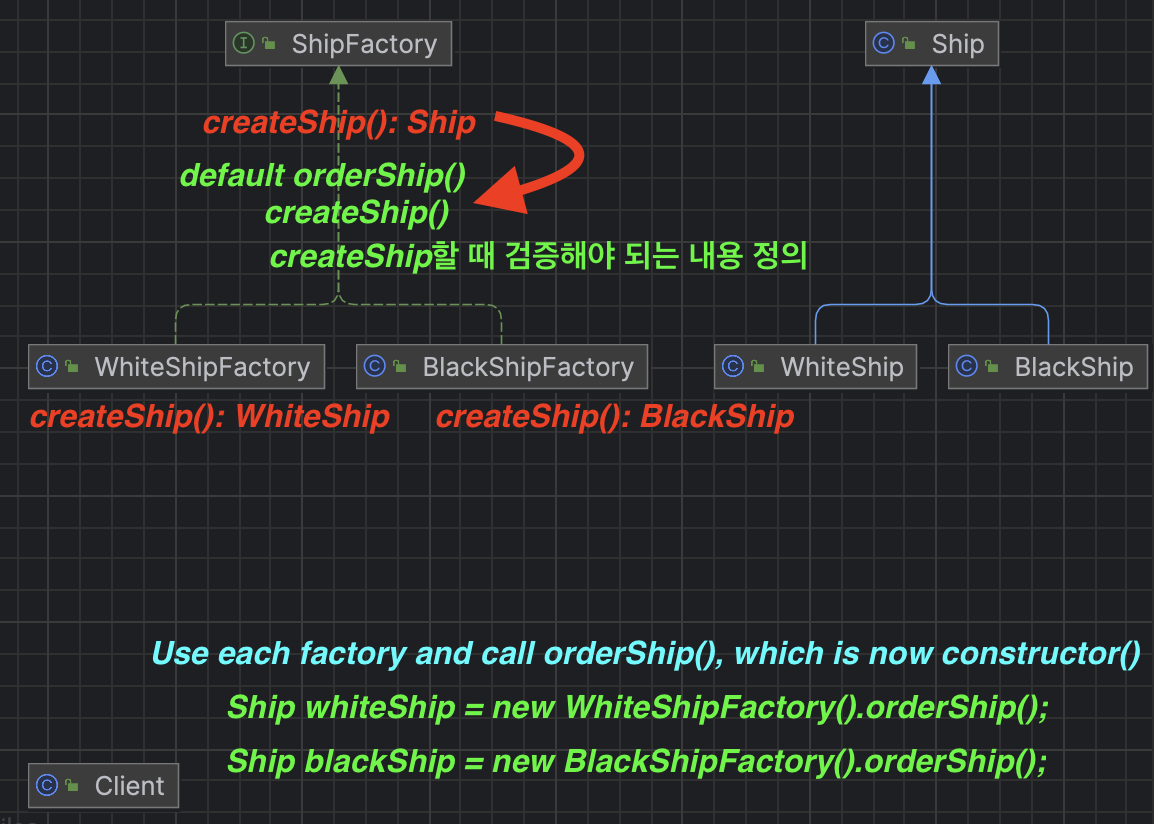
- ✔️ Class
Ship
1
2
3
4
5
6
7
8
public class Ship {
    private String name;
    private String color;
    private String logo;

  //getters
  //setters
}
- ✔️ Class
WhiteShipandBlackShip - ⭐️ How to set attributes of parent without using constructor
1
2
3
4
5
6
7
public class WhiteShip extends Ship {
    public WhiteShip() {
        setName("White Ship");
        setLogo("aaa");
        setColor("white");
    }
}
1
2
3
4
5
6
7
public class BlackShip extends Ship{
    public BlackShip() {
        setName("BlackShip");
        setLogo("bbbb");
        setColor("black");
    }
}
- ✔️ Interface ShipFactory
1
2
3
4
5
6
7
8
9
10
11
12
public interface ShipFactory {
  //default, could/could not be overrided
    default Ship orderShip(String name, String email){
        validate(name, email);
        Ship ship = createShip(); //use createShip();
        sendEmailTo(email, ship);
        return ship;
    }

    Ship createShip(); //not defined, must be overrided

}
validate(),sendEmailTo()are methods I want to run as soon as I create Ship✔️ Class WhiteShipFactory and BlackShipFactory
1
2
3
4
5
6
public class WhiteShipFactory implements ShipFactory{
    @Override
    public Ship createShip() {
        return new WhiteShip();
    }
}
1
2
3
4
5
6
public class BlackShipFactory implements ShipFactory{
    @Override
    public Ship createShip() {
        return new BlackShip();
    }
}
- ✔️ CLient code
1
2
3
4
5
6
public class Client {
    public static void main(String[] args) {
        Ship whiteShip = new WhiteShipFactory().orderShip("WhiteShip", "aaa@gmail.com");
        Ship blackShip = new BlackShipFactory().orderShip("BlackShip", "bbb@gmail.com");
    }
}
👍🏻 Advantages 👎🏻 Disadvantages
- 👍🏻 do not need to use else-if
- 👍🏻 open/closed principle: open for extension, closed for modification
- can create another function/interface without modifying the old code
- this is bc of coupling between class and constructor is loose
👍🏻 can use
defaultto write a default method ininterface- 👎🏻 need to create more classes
default and private in interface
- can use
defaultto define a method ininterface - and the helper methods for the
default methodshould beprivate - as it would be used only inside the interface
1
2
3
4
5
6
7
8
9
10
11
12
13
14
15
16
17
18
19
20
public interface ShipFactory {
    default Ship orderShip(String name, String email){
        validate(name, email);
        prepareFor(name);
        Ship ship = createShip();
        sendEmailTo(email, ship);
        return ship;
    }

  //helper methods inside default method
  //access modifier: private
  private void validate(String name, String email){

    }

    private void prepareFor(String name) {

    }
👀
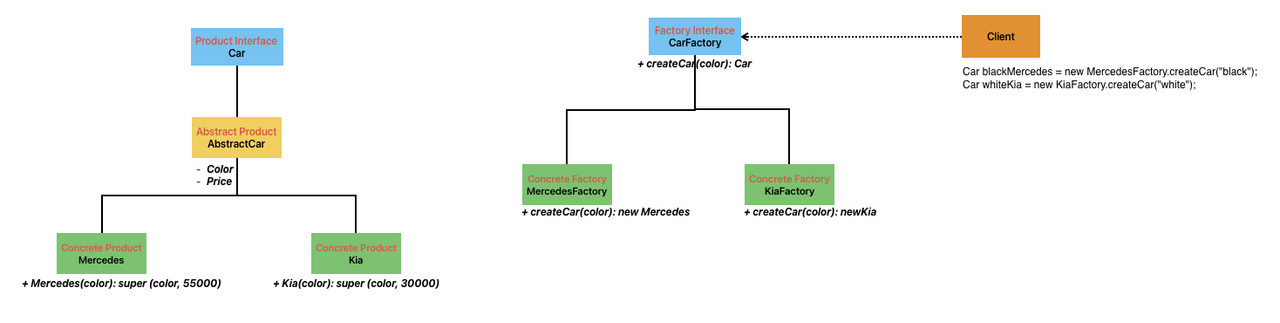
✔️ Product interface
1
2
3
4
public interface Car {
    //method that car can perform
    drive();
}
✔️ Abstract product
1
2
3
4
5
6
7
8
9
10
public abstract class AbstractCar implements Car {
    protected String color;
    protected double price;

    //constructor to use in concrete products
    public AbstractCar(String color, double price) {
        this.color = color;
        this.price = price;
    }
}
✔️ Concete products
1
2
3
4
5
6
7
8
9
10
11
12
13
14
15
16
17
18
19
20
21
public class Mercedes extends AbstractCar {

    public Mercedes(String color) {
        super(color, 55000);
    }

    @Override
    public void drive() {
    }
}

public class Kia extends AbstractCar {

    public Kia(String color) {
        super(color, 30000);
    }

    @Override
    public void drive() {
    }
}
✔️ Factory Interface
1
2
3
4
5
public interface CarFactory {

    Car createCar(String color);

}
✔️ Conrete Factory
1
2
3
4
5
6
7
8
9
10
11
12
13
14
15
public class MercedesFactory implements CarFactory {

    @Override
    public Car createCar(String color) {
        return new Mercedes(color);
    }
}

public class KiaFactory implements CarFactory {

    @Override
    public Car createCar(String color) {
        return new Kia(color);
    }
}
✔️ Client
1
2
3
Car blackMercedes = new MercedesFactory.createCar("black");

Car whiteKia = new KiaFactory.createCar("white");
This post is licensed under CC BY 4.0 by the author.