Behavioral_Command Pattern
✅ Command Pattern
- encapsulate the request
- decouple
invoker(호출자)andreciever(수신자) - 👍🏻 when request logic changes,
invokercode will not change
✅ Diagram
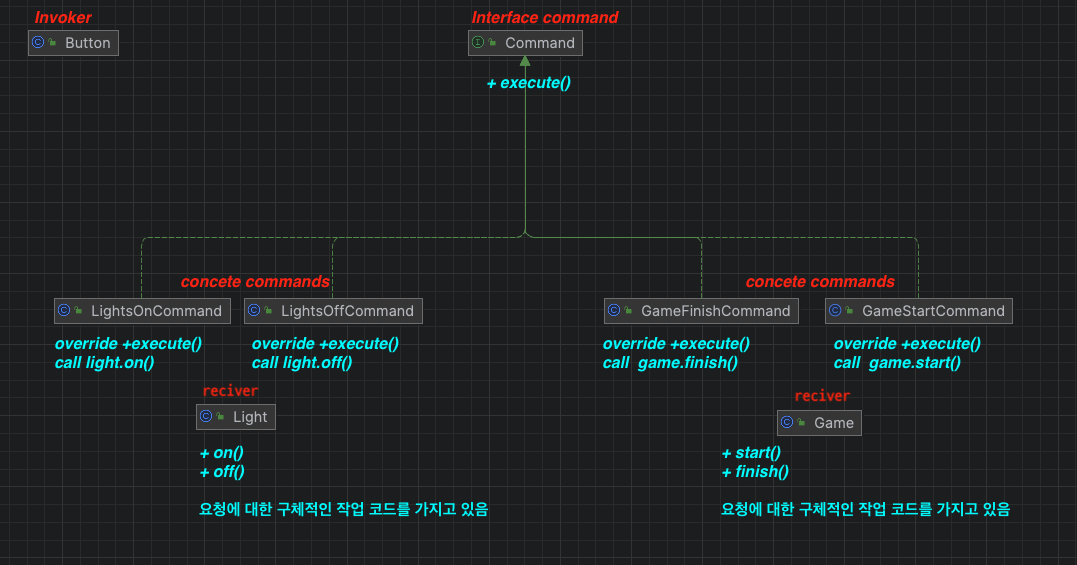
👀 Command pattern example
✔️ Invoker class
- the invoker does not know the logic behind the commands
- even if command changes, just have to
pressthe button (invoke) - and the changed logic will run
- without having to change
invokercode
1
2
3
4
5
6
7
8
9
10
11
12
13
14
15
16
17
18
19
20
21
//Invoker code will never change even if command changes
public class Button {
    private Command command;

    public Button(Command command) {
        this.command = command;
    }
    public void press(){
        command.execute();
    }

    // main class
    public static void main(String[] args) {
        Button button1 = new Button(new LightsOnCommand(new Light()));
        button1.press();

        Button button2 = new Button(new GameStartCommand(new Game()));
        button2.press();

    }
}
✔️ Command interface
1
2
3
public interface Command {
    void execute();
}
✔️ concrte command interfaces
1
2
3
4
5
6
7
8
9
10
11
12
13
14
15
16
17
18
19
20
21
22
23
24
25
26
27
28
29
30
31
32
33
34
35
36
37
38
39
40
41
42
43
44
45
46
47
48
49
50
51
public class LightsOnCommand implements Command{
    private Light light;

    public LightsOnCommand(Light light) {
        this.light = light;
    }

    @Override
    public void execute() {
        light.on();
    }
}

public class LightsOffCommand implements Command{
    private Light light;

    public LightsOffCommand(Light light) {
        this.light = light;
    }

    @Override
    public void execute() {
        light.off();
    }
}

public class GameStartCommand implements Command {
    private Game game;

    public GameStartCommand(Game game) {
        this.game = game;
    }

    @Override
    public void execute() {
        game.start();
    }
}

public class GameFinishCommand implements Command {
    private Game game;

    public GameFinishCommand(Game game) {
        this.game = game;
    }

    @Override
    public void execute() {
        game.start();
    }
}
✔️ reciever classs
- has the specific logic to run
- when command is called
1
2
3
4
5
6
7
8
9
10
11
12
13
14
15
16
17
18
public class Light {
    public void on(){
        //specific logic
    }
    public void off (){
        //specific logic
    }

}

public class Game {
    public void start(){
        //specific logic
    }
    public void finish(){
        //specific logic
    }
}
✅ Using stack with command pattern ➡️ undo
- can
stackthe commands - and call on
undo - 실행취소 구현하기
1
2
3
4
5
6
7
8
9
10
11
12
13
14
15
16
17
18
19
20
21
22
23
24
25
26
public class Button {
    private Stack<Command> commands = new Stack<>();

    public void press(Command command){
        command.execute();
        commands.push(command);
    }

    public void undo(){
        if(!commands.isEmpty()){
            Command command = commands.pop();
            command.undo();
        }
    }

    public static void main(String[] args) {
        Button button1 = new Button();
        button1.press(new LightsOnCommand(new Light()));
        Button button2 = new Button();
        button2.press(new GameStartCommand(new Game()));

        button1.undo();
        button2.undo();

    }
}
👍🏻👎🏻
- 👍🏻 can create new command without modifying invoker
- 👍🏻 even when command logic changes, invoker will not change
- 👉🏻 Open Closed principle
🛠️
Executor: library to create thread to run asynchronizedRunnableSimpleJDBCInsert
1️⃣
2️⃣
3️⃣
4️⃣
- 1️⃣
- 2️⃣
- 3️⃣
- 4️⃣ 👍🏻 👎🏻
1
2
3
⭐️⭐️⭐️ EXAM ⭐️⭐️⭐️
❓
👉🏻
This post is licensed under CC BY 4.0 by the author.