1.11 Microprocessor- Multicore and Multithreading
- ⭐️ concept of multicore, multi thread
- ⭐️ FSB, BSB
- ⭐️ memory controller
- ⭐️ transport bus
- ⭐️ GPU
✅ Multicore

- CPU is multicore if the
neumann machineis replicated several times - However, even if replicated, not all blocks are replicated
✔️ In CU
clock, sequencer is NOT replicated
clock: NOT replicated❌ we need only one bosssequencer: NOT replicated❌ only one clock, only one sequencer to set only one rythmProgram counter: Replicated⭕️ each core has onePC, every core can run own instuctions, everyPCpointing to their own address and has each has own instructions, this is multi-taskingInstruction Register: Replicated⭕️ as each core has eachPCDecoder: Replicated⭕️ to helpIR
✔️ In ALU
ALL replicated
InRAandInRA: Replicated⭕️Operational Circuit: Replicated⭕️ACCUM: Replicated⭕️State Register: Replicated⭕️- 👉🏻 Thus, all
ALU blocksare replicated - bc all the instructions use different numbers
- 👉🏻 Thus, all
✔️ In MU
RAM is unique
Memory Controller
- The
RAMis unique, outside the micro-processor - thus the
RAMis NOT replicated❌ - However, as 4 instructions are running at the same time,
MAR,MDRandMSwill be more stressed! - 4 instructions will come at the same time
- 😫 So
RAMis unique, but the internal blocks(MAR,MDR,MS) will be more stressed - 💊 Memory Controller: So we have a super block
- So instead of having
MAR,MDR,MS, we haveONE BIG BLOCKfor controlling everything - This huge block works simillar to replicating the
RAM blocks(MAR,MDR,MS), and reduces the stree of theRAM - sometimes, next to the
Memory Controller, there is aSystem Agent block - System Agent block: to help coordinate several
RAMs When you have several
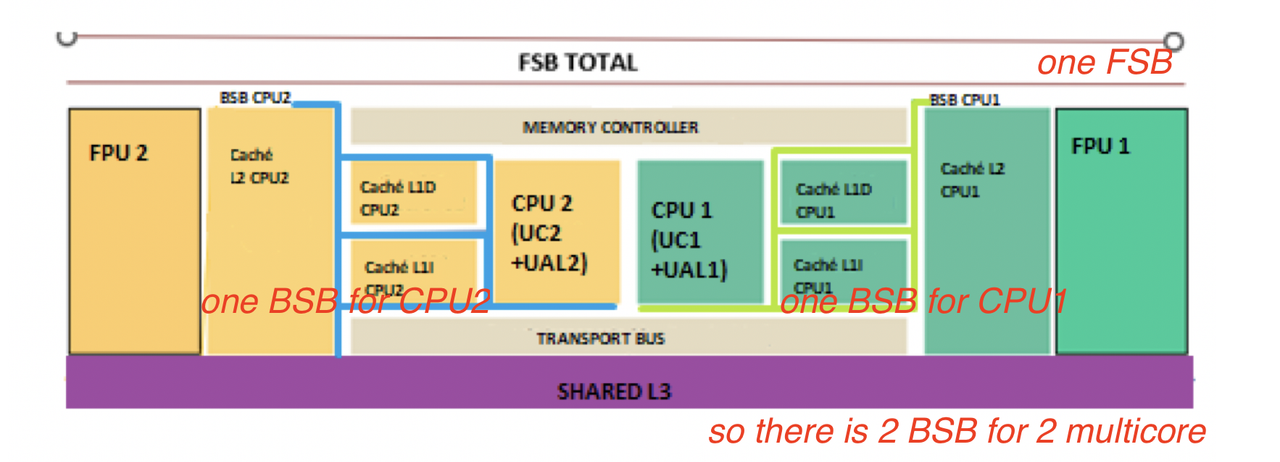
RAMs, theSystem Agent blockhelps coordinating thedivided RAM- In the picture, there are
4 cores, so there are4 neumann machines - So if we have
4 cores, we will have- one clock, one sequencer
- 4
PCs,IRsandDecoder, all blocks ofALU blocks
- if we have
4 coreswe can run 4 instructions at the same time simultaneously - And we have one RAM, but we have
Memory Controller
✔️ In Peripherals
Transport Bus
- 😫 In multicore, the peripherals are also collapsed, very stressed running several instructions at the same time
- 💊 Transport Bus(also called Input/Output memory controller (I/O))
- used for controlling the peripherals at a very high speed
- ⭐️ In the exam, this block will be called
Transport Bus⭕️, and NOTInput/Output memory controller❌
☑️ Graphics Processing Card
- If we are multicore, there can be a portion named
GPU - however, not mandatory
- helps the other standard graphics card with the graphics(images, videos)
- 🛠️ For games, music, movies
✅ Back Side Bus BSB
road inside core
- Each core inside has an internal sturcture for communication
- like internal streets/roads
- ⭐️ one
BSBper core - one core will have their own
BSB - 🐢
BSBis relatively slower toFSB
1
2
3
4
5
❓ If in core 3, the data from InRA is 3,
but cannot reach the OC,
what is the problem?

A: The BSB in core 3 is broken, having problems.
✅ Front Side Bus FSB
road to communicate among cores
- Apart from
BSB, there is a circular highway to communicate AMONG cores - circular road to connect all the cores
- ⭐️ there is only ONE
FSBin one computer
1
2
3
❓ In 4 core computer, how many BSB and FSB?

A: There will be 4 BSBs and 1 FSB
- Sometimes, we have to send information from one core to another
- 🛠️ Then we need to use
FSB
1
2
3
❓ If the result of operation 1 in core 1 cannot reach InRB of core 4, what is the problem?

A: The FSB is not working properly.
✔️ Speed of FSB
- 🐇
FSBis the fast speed bus - If my clock has 2GHz, my
FSBtends to be2GHztoo so the
FSBhas more or less same speed as the clock- If the clock is much faster than the
FSB, it means there is a bottleneck in theFSB - example: If my
clock is 2.5GB, and myFSB is 1GHz
✅ How many cores?
- In computing, every number should be a
power of 2 1 core: mono-core- However, sometimes core is not a
power of 2, for example:6 core computer - then, it means
4 coreand2 coresare for mirroring - 🛠️ for protection, backups
1
2
3
4
❓ In a 8 core computer, what is the result of this?
FSB + BSB + MC + TB
= 1 + 8 + 1 + 1
= 11
✅ Multi-thread
Dividing one process into several execution threads
- each of the threads(parts of process) will be processed by different blocks
- If you want your job to be done without interruption/disconnection
- use an independent execution thread
✔️ Resource sharing in multi-thread
- being multi-threading means more or less multi-tasking
you can only do multi-threading if you have a resource sharing technique
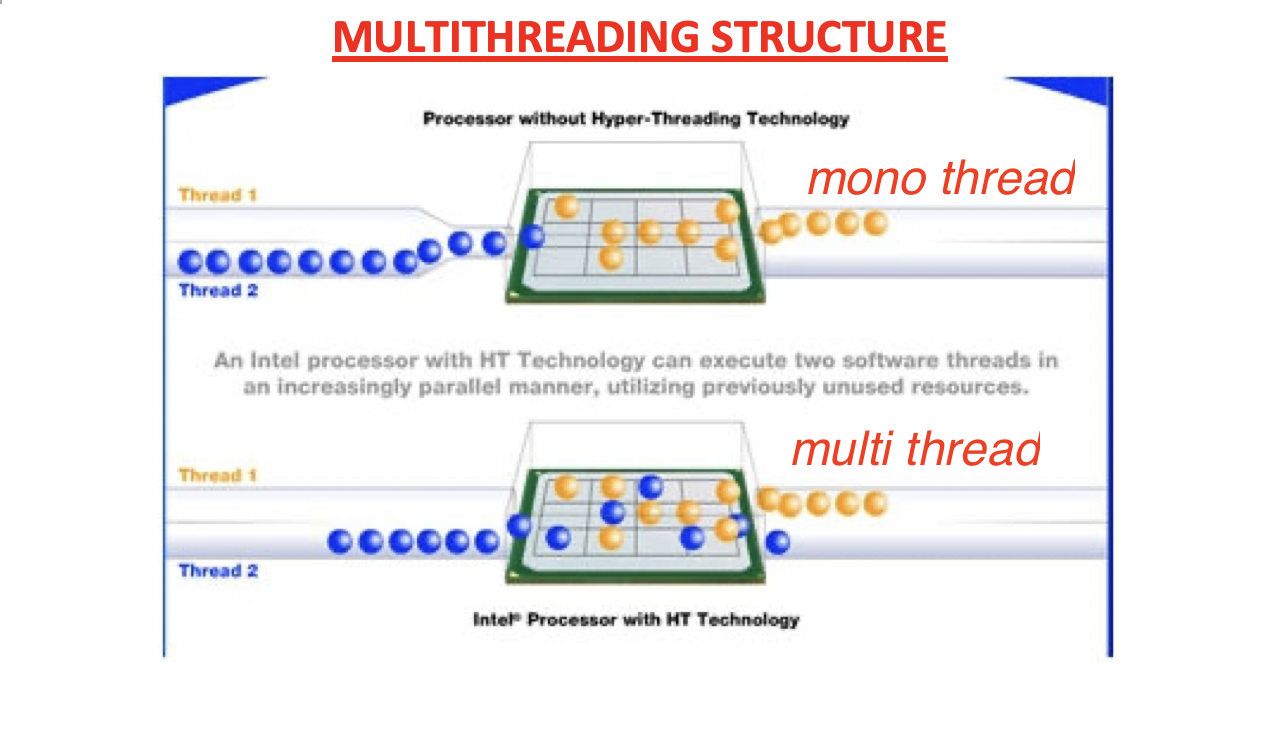
Mono thread: takes the whole micro processor to itself- yellow runs, then blue
Multi thread: the threads have to share the micro processorThe microprocessor would do blue and yellow at the same time
- If I am multi-core, it is easy to be multi-thread
- If you have many cores, it does NOT necessarily mean your computer is faster ❌
- It means your computer can run more things at the same time
- It means your computer micro processor is more stressed, more hotter, need to ventilate more, need to refresh your computer more
✔️ Optimization
- If you are mono-core you can be multi-thread ⭕️
- But you have to share your resources very well
- 💊 Optimization tools: help share resources among threads in mono-core
✅ Logic Core
Physical core: number of cores we have,8 core = 8 physical coreThreads per core: how many thread in a coreLogic cores: how many threads I have in total
1
2
3
4
5
6
7
8
9
10
❓ If we have 4 cores, and each core executes 2 threads, how many threads in total can we execute?
A: 8 threads in total

Physical core: 4
Threads per core: 2
Logic cores: 8

I have a computer of physical core of 4, thread per core is 2
then I have 8 logic cores
⚠️ I have 4 physical cores, but have 8 logic cores, bc I feel like I have 8 workers!
✅
✅
This post is licensed under CC BY 4.0 by the author.